
If you’re an engineering or science student in India aiming for higher studies, research, or a stable career in public sector companies — the GATE Exam (Graduate Aptitude Test in Engineering) is probably one of the most important exams you’ll take. It serves as a national-level standardised test to assess understanding of undergraduate-level concepts across engineering, technology, science, architecture, and more. A good GATE score can unlock entry into top-tier postgraduate courses (like MTech, ME, PhD), secure seats in prestigious institutions, and even pave the way to Public Sector Undertakings (PSU) jobs — all based solely on merit.
For 2026, as always, GATE remains a gateway to academic prestige and career opportunities, but with some fresh changes that make it more flexible and relevant than ever.
Who’s Conducting GATE 2026 & What’s New This Year
Organising Institutes

The 2026 edition of GATE is being conducted by IIT Guwahati, in coordination with Indian Institute of Science (IISc) and the rest of the IITs under the oversight of the relevant central authorities.
Significant Updates: New Subjects & Flexible Options
This year brings in some noteworthy changes meant to broaden access and flexibility. For example:
A new “Energy Science” paper has been added to the list of test papers.
Candidates now have more flexibility when it comes to paper combinations — this dual-paper option allows aspirants to pick two papers depending on their background and interests.
The eligibility criteria and registration guidelines have been revised for clarity and inclusivity.
These updates reflect how GATE is evolving to match changing academic and professional landscapes — more options, more flexibility, more opportunities.
Important Dates & Events for GATE 2026
Registration Start & Deadline
The online registration (via the official portal: gate2026.iitg.ac.in) opened on August 28, 2025.
The regular registration window (without late fee) closed on September 28, 2025.
For those who missed the regular deadline, the extended registration (with late fee) remained open until October 9, 2025.
Exam Dates & Shift Timings
The exam is scheduled for February 7, 8, 14, and 15, 2026 — all on Saturdays and Sundays.
Each day will have two sessions:
Morning shift: 9:30 AM – 12:30 PM
Afternoon shift: 2:30 PM – 5:30 PM
Admit Card, Result Declaration & Score Validity
Admit cards are expected to be released from January 02, 2026.
Results are scheduled to be announced on March 19, 2026.
GATE 2026 scorecards will be valid for three years from the date of result — useful for higher studies, PSU applications, and other opportunities.
Eligibility & Who Can Apply (Including Relaxed Criteria)
GATE has always been inclusive, and 2026 continues that trend. Eligible applicants include those who are currently in the third or higher year of an undergraduate degree programme, or those who have already completed a government-recognised degree in engineering, technology, architecture, science, commerce, arts, or humanities.
Also — institutions outside India whose degrees are equivalent to Indian recognised degrees may also be considered, subject to approval. This opens the door for many to apply, even if their educational background is diverse.
Exam Pattern, Papers & What’s Changed in 2026
Number of Papers; New Additions
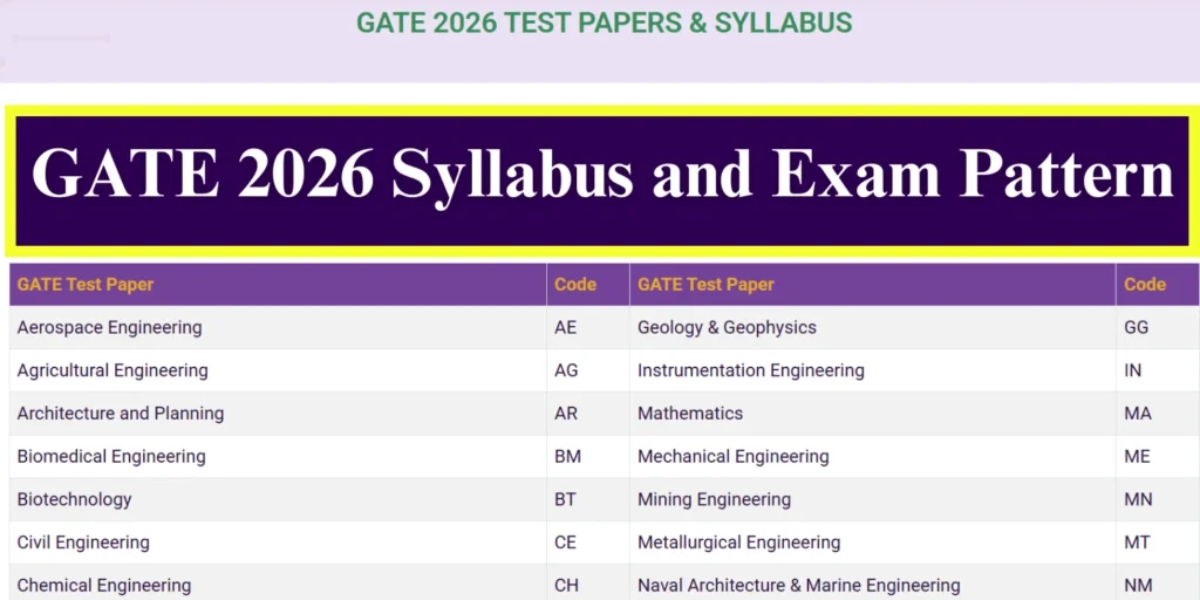
GATE 2026 will cover 30 test papers, spanning multiple disciplines — engineering, technology, science, and more.
The newly added subjects (like Energy Science) reflect growing interdisciplinary demands and broaden the scope for aspirants.
Dual-Paper Option and Flexibility
One of the big draws this year is the option to choose two papers — a move aimed at offering greater flexibility to candidates whose academic and career interests span different fields.
This flexibility can be a real advantage for someone who wants to keep multiple options open — for example, a student of mechanical engineering opting for a second paper in Energy Science or a related field.
Mode of Exam (CBT) & General Aptitude Component
Just like previous years, GATE 2026 will be held in Computer-Based Test (CBT) mode across exam centers nationwide.
Each paper will carry 100 marks, typically including a General Aptitude (GA) section along with the core subject paper — ensuring a balance between technical knowledge and reasoning/aptitude skills.
Tips for Aspirants: How to Prepare Smart for GATE 2026
If you’re planning to appear for GATE 2026, here are a few tips to keep you ahead:
Start early: With dual-paper option and expanded syllabus, having more preparation time gives you an edge.
Focus on fundamentals: GATE tests your understanding of core undergraduate concepts. Build strong basics before diving into advanced topics.
Use past papers and mocks: Practising previous years’ GATE papers and timed mocks helps you familiarise with pattern and time-management.
Choose papers wisely: If opting for two papers, pick ones that complement each other (for example, a core engineering + an emerging interdisciplinary paper).
Balance GA and technical prep: General Aptitude section can’t be ignored — make sure to polish reasoning, verbal and quantitative skills too.
What to Do After GATE — Opportunities & How to Leverage It
Once you get your GATE 2026 score:
Apply for postgraduate programs (MTech/ME/PhD) at reputed institutions.
Use the score to apply for PSU recruitments or research positions — many PSUs accept GATE as qualifying criteria.
Consider international universities or research institutes which recognise GATE scores (if you wish to study abroad).
Explore scholarship or fellowship opportunities — many academic institutions and research projects value a strong GATE score.
In short: treat GATE 2026 not as an end but a stepping stone — a key that can open multiple doors.
Conclusion
GATE 2026 is shaping up to be a landmark edition — with broader eligibility, new subject options, dual-paper flexibility, and a thoughtfully designed schedule that addresses real aspirant concerns. Whether you’re a fourth-year student, a fresh graduate, or someone looking for a career pivot — this exam offers a powerful platform for higher studies, research, or stable employment in PSUs and beyond.
The expanded scope and flexibility mean the competition will be tougher — but with smart preparation and strategic planning, GATE 2026 could be your ticket to success.
So if you’re reading this and planning to appear — treat these next few months as your launchpad. Work hard, stay focused, and let GATE 2026 be the bridge to your future.
Read also: 2026 CBSE Board Exam Latest News Dates Syllabus Pattern